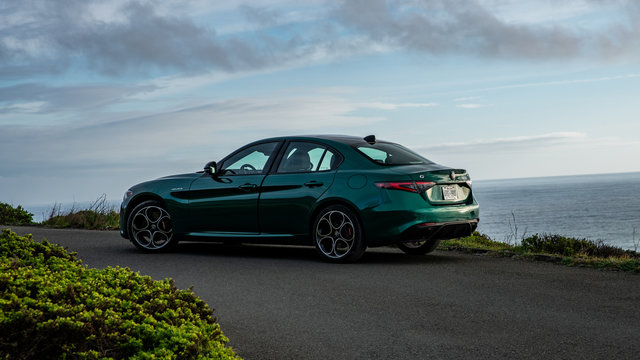
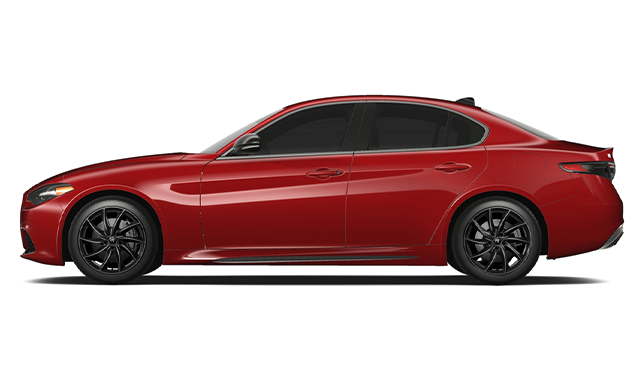
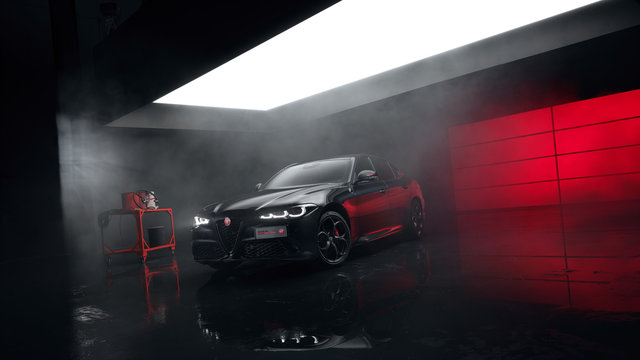
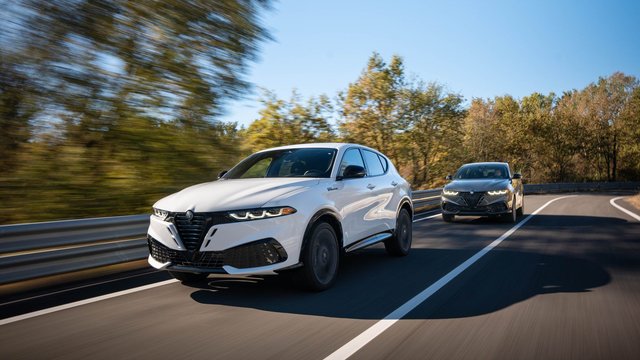
The 2026 Alfa Romeo Giulia is a sport sedan built around a specific idea: that all-wheel drive and rear-wheel-drive character do not have to be opposites. The powertrain that makes this possible is a 2.0 L turbocharged 4-cylinder engine producing 280 hp and 306 lb-ft of torque, paired with an 8-speed automatic transmission and a rear-biased Q4 all-wheel-drive system. Understanding how these three components interact helps explain why the Giulia behaves the way it does in daily driving, on wet roads, and when pushed on a winding stretch of pavement.
This article breaks down the mechanical relationship between the engine, the gearbox, and the AWD system. If you are considering a sport sedan and want to understand what the Giulia’s powertrain actually does rather than what marketing language says about it, this is the right place to start.
The Engine: 2.0 L Turbo I-4, 280 hp and 306 lb-ft
The Giulia’s engine is an all-aluminum 2.0 L turbocharged 4-cylinder with direct injection. It produces 280 hp and 306 lb-ft of torque, with the peak torque figure available from 2,000 rpm through 4,800 rpm. That wide torque band is the reason the Giulia responds quickly to throttle inputs without requiring a high-revving approach to extract performance.
The engine sends its output to the 8-speed automatic before any torque reaches the wheels. The transmission uses steering-column-mounted aluminum paddle shifters, allowing the driver to take manual control of gear selection without removing their hands from the wheel. Shifts in automatic mode happen in under 100 milliseconds, which keeps response time tight during spirited acceleration. The result is a 0-96 km/h time of an estimated 5.1 seconds and a top speed of 249 km/h.
Engine and transmission at a glance: - 2.0 L turbocharged 4-cylinder, 280 hp and 306 lb-ft of torque - Peak torque from 2,000 to 4,800 rpm - 8-speed automatic transmission, gear shifts in under 100 milliseconds - Steering-column-mounted aluminum paddle shifters standard - 0-96 km/h in an estimated 5.1 seconds; top speed 249 km/h
What Rear-Biased Q4 AWD Means in Practice
The Giulia uses a rear-biased Q4 all-wheel-drive system, and understanding what “rear-biased” means is the key to understanding the car’s personality. Under normal driving conditions, the Giulia behaves like a rear-wheel-drive sedan. The majority of torque goes to the rear axle. The front wheels are not receiving constant drive force, which keeps the steering responsive and preserves the handling balance that defines the Giulia’s driving character.
The AWD system monitors wheel speed, steering angle, and throttle input continuously. When those inputs indicate that additional traction is needed at the front axle (during a low-grip corner entry, a sudden acceleration in rain, or a slippery departure from a stop) the Active Transfer Case routes torque forward. This happens quickly and without the driver needing to take any action.
The practical outcome is a car that offers two things at once. In dry, normal conditions, it drives with the sharp, responsive feel of a rear-driven vehicle. In conditions where traction is reduced, it adds front-axle support automatically. The system is not a simple on/off switch between modes. It is constant, active torque management that adjusts in real time to what the road and the driver are asking of the car.
The Alfa DNA Drive Mode Selector
The three-mode Alfa DNA selector directly changes how the powertrain and AWD system respond to driver inputs. Each mode adjusts engine mapping, throttle sensitivity, transmission shift points, and suspension tuning simultaneously.
Dynamic mode sharpens throttle response, holds gears longer, and biases the car toward rear-axle involvement in a way that produces a more engaging feel. Natural mode delivers a neutral, balanced setup suited to everyday driving, where comfort and efficiency are the priority. Advanced Efficiency mode adjusts shift timing and throttle mapping to reduce fuel consumption during lower-demand driving.
These modes do not override the AWD system’s protective function. In any mode, the Q4 system will still route torque to the front axle if the rear wheels lose grip. The DNA selector changes the driving experience, not the car’s ability to stay composed when traction conditions change.
The Carbon Fibre Driveshaft and Weight Distribution
Two details in the Giulia’s architecture reinforce the powertrain’s performance orientation. First, the driveshaft connecting the transmission to the rear axle is made from carbon fibre. Carbon fibre is lighter than steel and stiffer under load, which means the driveshaft adds less rotational mass and transmits torque more directly. In a performance context, this reduces drivetrain loss and improves response.
Second, the Giulia achieves a 50/50 weight distribution between the front and rear axles. This is uncommon in a front-engine vehicle. The longitudinal engine layout, low-mounted components, and aluminum construction in the front and rear frames all contribute to this balance. A 50/50 weight distribution means the car enters and exits corners without the handling imbalance that comes from having most of the vehicle’s mass over either axle.
How the Brembo Brake System Works With the Powertrain
The Giulia’s braking system uses Brembo four-piston aluminum-monoblock front calipers with single-piston rear calipers. Brembo calipers are a fixed-piston design, which means the caliper body does not move when the brakes are applied. All four pistons clamp simultaneously, producing consistent, fade-resistant braking force.
In the context of the Q4 AWD system, the brake system works alongside electronic brake-force distribution and anti-lock brake technology to manage deceleration across all four wheels. When the AWD system is actively routing torque to the front axle during a corner, the braking system can modulate force individually per wheel to maintain the car’s composure during deceleration. This happens automatically, without driver input.
At a Glance: 2026 Alfa Romeo Giulia Powertrain Summary
|
Specification
|
Detail
|
|
Engine
|
2.0 L turbocharged 4-cylinder, all-aluminum
|
|
Power
|
280 hp
|
|
Torque
|
306 lb-ft (2,000-4,800 rpm)
|
|
Transmission
|
8-speed automatic
|
|
Paddle Shifters
|
Aluminum, column-mounted, standard
|
|
AWD System
|
Rear-biased Q4, Active Transfer Case
|
|
0-96 km/h
|
Estimated 5.1 seconds
|
|
Top Speed
|
249 km/h
|
|
Driveshaft
|
Carbon fibre
|
|
Weight Distribution
|
50/50 front-to-rear
|
|
Brakes
|
Brembo four-piston front calipers
|
Visit Scotti Alfa Romeo in Saint-Léonard to Experience the Giulia’s Powertrain
Understanding the Giulia’s engineering on paper is one thing. Experiencing the 280 hp turbocharged engine, rear-biased Q4 AWD, and 8-speed automatic in motion is another. Visit the team at Scotti Alfa Romeo in Saint-Léonard to get behind the wheel of the 2026 Giulia and feel how the powertrain works in real driving conditions. The team can walk you through trim options, packages, and any technical questions you have before you decide.